
Asphalt patching
Targeted repairs for localized failures. We cut back to solid edges, remove unstable material, repair the base as needed, and install new asphalt so the patch is tied into the existing pavement.
Serving Pittsburgh, Pennsylvania & surrounding areas
Mon–Fri 8am–6pm · Sat 9am–2pm
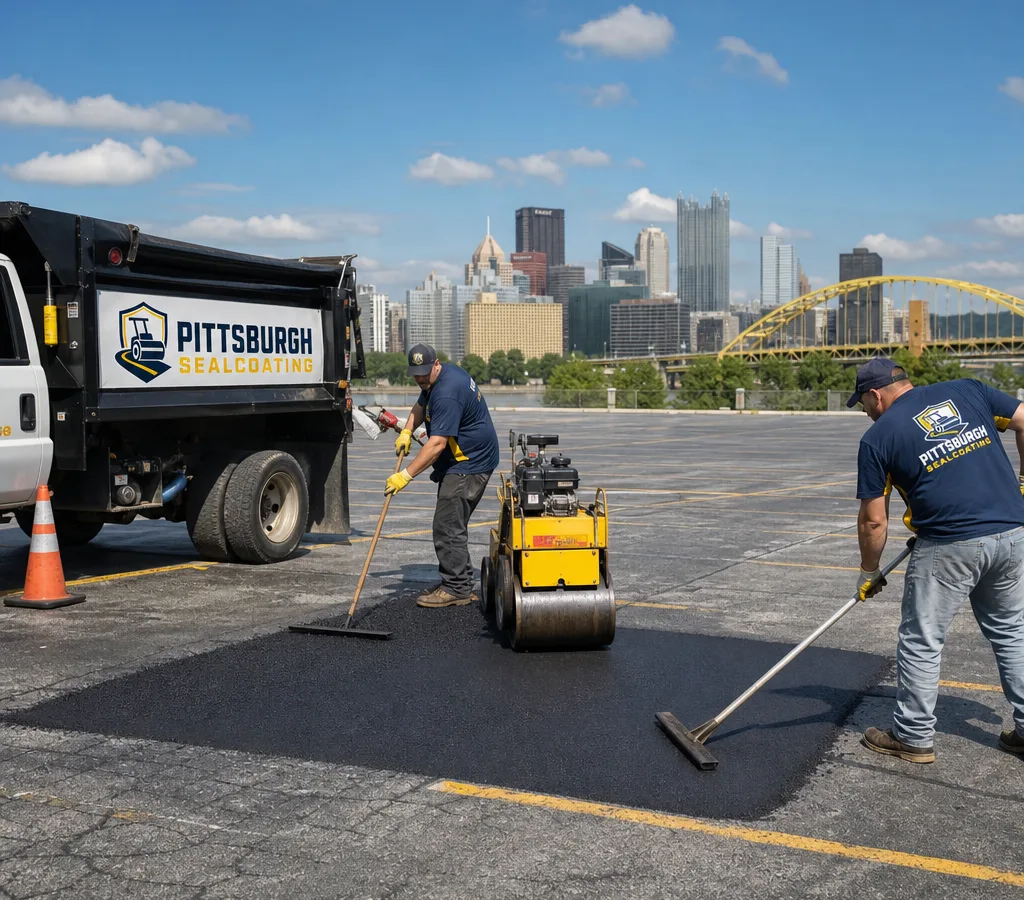
Asphalt repair · Pittsburgh, PA
Fix potholes, cracking, and failing edges before water and traffic turn small defects into expensive replacement. Get a clear scope, the right repair method, and durable blacktop results for driveways and parking lots.
Pittsburgh pavement repair
If you are looking for asphalt repair Pittsburgh property owners can rely on, the goal is simple: stop water from getting into the base and stop traffic from breaking the pavement apart. Most surface failures start the same way. A small crack lets water in, freeze-thaw cycles pry the crack wider, and repeated turning or braking loads start to loosen the edges. Once the base is wet or soft, the top mat moves, ruts, and potholes form.
Asphalt repair is the practical middle ground between doing nothing and full replacement. Depending on the damage, the right fix might be asphalt patching, pothole repair, edge repair, or targeted pavement maintenance to keep sound areas sealed and draining correctly. We match the repair to what is happening under the surface, not just what it looks like from the curb.
You will see these issues across Pittsburgh in both residential and commercial settings:
Pittsburgh's hills and stop-and-go traffic add stress too. Steep approaches and intersections increase braking and turning forces, so small cracks can spread faster if drainage is not handled and repairs are delayed.
Repair capabilities
Targeted repairs for localized failures. We cut back to solid edges, remove unstable material, repair the base as needed, and install new asphalt so the patch is tied into the existing pavement.
Potholes need more than a quick fill. Proper pothole repair includes squaring the hole, cleaning it out, addressing wet or soft base conditions, and compacting in lifts to reduce early settlement.
Driveway repair in Pittsburgh often means fixing wheel-path cracking, heaved edges, and drainage problems that dump water onto the pavement. The best repair keeps water moving away from the driveway.
Parking lot repair focuses on high-load zones like entrances, dumpster pads, and turning lanes. Repairs can be staged to keep traffic moving and limit downtime for tenants and customers.
Blacktop repair may include edge reconstruction, crack prep, leveling for birdbaths, and transitions at aprons or ramps. Good repairs feel smooth under tires and drain correctly after rain.
Pavement maintenance helps you avoid repeated emergency fixes. We can outline which sections need repair now and which areas can be protected with routine sealing at the right time.
Pavement assessment
A durable repair starts with one question: is the base still stable? Surface sealing alone cannot fix base failure, and deep patching is overkill when the structure is sound.
During an on-site visit, we look for:
For many pavement repair Pittsburgh properties need, the sequence is cut, remove, re-compact, then install hot mix and compact to match surrounding grade. Where the surrounding pavement is still in good shape, a cleaner saw-cut patch with tight seams typically lasts longer than irregular “feathered” edges.
If you are also budgeting for protective sealing after repairs, Pittsburgh Sealcoating can coordinate timing so repairs are fully cured and the surface is prepared correctly before any sealing is applied. You can get a sense of what that maintenance involves through our sealcoating services.
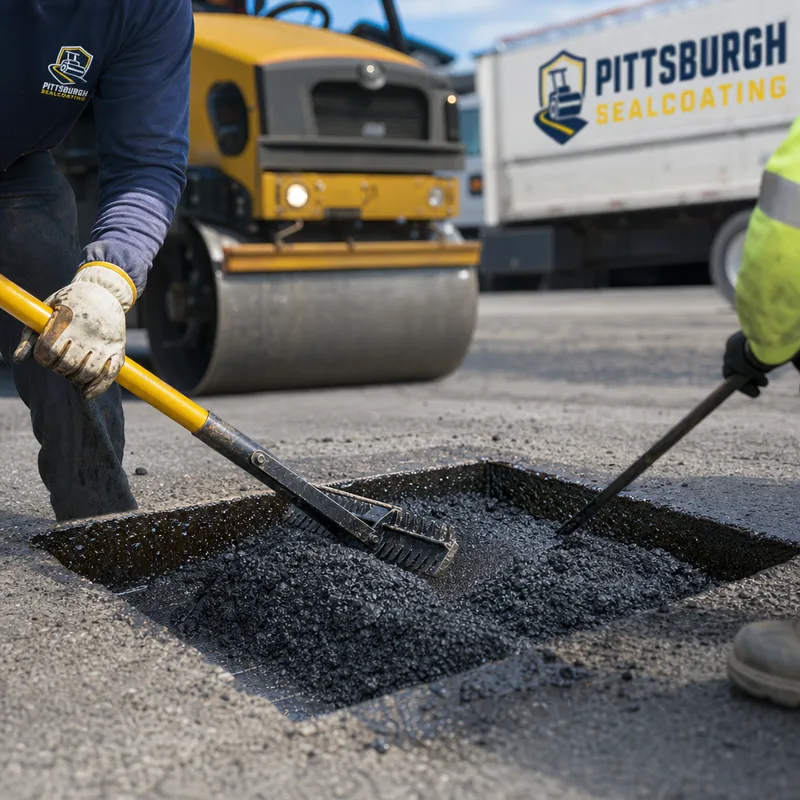
Assessment to finish
We look at cracking patterns, drainage flow, and traffic paths, then mark repair areas so the scope is clear. For parking lots, we note entrances, turning zones, and any areas that must stay accessible.
Failed asphalt is cut back to solid material and removed. If the base is wet, pumping, or soft, we address it before any new asphalt goes in.
Hot mix asphalt is placed in lifts and compacted to density, then matched to surrounding grade so water drains instead of collecting at the patch edges.
We tighten up edges, clean the work area, and confirm transitions at joints and drive approaches. A neat edge line and correct height reduce early edge cracking.
If there are other at-risk areas, we outline priority repairs versus routine asphalt maintenance so you can plan work instead of reacting to potholes.
Property-based pricing
Asphalt repair in Pittsburgh typically ranges from about $450 to $2,500+ for small to mid-sized repairs, with larger parking lot repair areas and base reconstruction costing more. A simple pothole repair or small asphalt patch often lands toward the low end, while saw-cut removals, multiple patches, and regrading for drainage push the price up.
Final cost depends on the square footage and thickness, how much base work is needed, access for equipment, traffic control requirements, and whether the surrounding pavement needs prep to make a clean tie-in. The exact price is confirmed after an on-site inspection and a written scope.
Customer proof
“We had a pothole that kept coming back at the entrance. They cut it out properly, fixed the base, and the patch has stayed tight through a full winter.”
“Our driveway had cracking in the wheel paths and a low spot that always held water. The repair leveled it out so it drains, and the surface looks consistent instead of a rough fill.”
Practical answers
Most asphalt patching can be completed in a few hours, and traffic is often allowed the same day once the material has cooled and set. Exact timing depends on patch size, location, and whether multiple lifts or base repairs are needed, which is common on pothole repair work after heavy rain or freeze-thaw.
A saw-cut patch usually holds up better when the surrounding asphalt is cracked or the edges are broken, because it creates clean vertical faces and lets the new asphalt lock in. A simple fill may be acceptable for a small, tight defect, but recurring potholes often point to wet base conditions that need to be addressed during pavement repair.
Alligator cracking usually means the pavement structure is failing under load, often from a weakened base or repeated traffic in the same wheel paths. In Pittsburgh, water intrusion and freeze-thaw cycles can accelerate the problem, so driveway repair often includes removing the failed area and rebuilding it rather than sealing over it.
Yes, many parking lot repair projects can be phased so tenants and customers still have access. The key is planning the sequence, staging materials and equipment, and keeping safe paths around active work areas while sections are patched and compacted.
Repairs should be completed before any surface sealing so failed areas are rebuilt and the surface is uniform. Sealing over cracking or potholes hides the problem for a short time but does not fix the structure, so it is better to handle asphalt repair first, then plan pavement maintenance for protection.
If damage is localized, the base is stable, and most of the pavement still drains and feels solid underfoot, targeted asphalt repair is often the right move. If large areas are rutted, the surface is crumbling across most of the lot or driveway, or patches are failing repeatedly in many locations, replacement may be more cost-effective. An on-site evaluation makes that call based on what is happening under the surface.
Free property inspection
Tell us what you are seeing, where it is happening, and how the area is used. We will inspect the pavement, recommend the right repair method, and provide a written scope for your driveway or parking lot in Pittsburgh.